One of the core concepts in the digital marketing industry is the sales funnel. While odd sounding at first, this single core concept can take a business from virtually non-existent and unknown to multi-million-dollar marketing machine with mass saturation, seemingly overnight. In fact, there are skilled practitioners who have built a career around implementing this single concept in business.
If you're wondering what a sales funnel is, simply imagine a real-world funnel. At the top of that funnel, some substance is poured in, which filters down towards one finite destination. In sales, something similar occurs. At the top, lots of visitors arrive who may enter your funnel. However, unlike the real-world funnel, not all who enter the sales funnel will reemerge out from the other end.
In marketing automation, Ryan Deiss, co-founder of Digital Marketer, often describes the sales funnel as a multi-step, multi-modality process that moves prospective browsers into buyers. It's multi-stepped because lots must occur between the time that a prospect is aware enough to enter your funnel, to the time when they take action and successfully complete a purchase.
There are email warming sequences that include things like personalized value-driven stories, tutorials and even soft pushes to webinars, and of course product suggestions that happen over days or even weeks. The truth is that most prospects won't buy from your website at first glance, especially if they're only just becoming aware of you today. It takes time. Thus, the funnel is a multi-modality process, as there are a variety of relationship-building experiences and "touches" that occur through several stages.
Much of this is steeped in buyer psychology. The best marketers in the world know that there is a psychological process that must occur for prospects to whip out those credit cards and turn into buyers or even hyper-active buyers. One such person whose perfected this process is Russell Brunson, an "underground entrepreneur" who founded a company called ClickFunnels, a sales funnel SaaS business that empowers marketers from around the world to build marketing automation without all the hassle.
As a software engineer myself, I can tell you that building funnels from an application standpoint takes massive amounts of work. There's a great deal of coding and integration that's required here. From email systems to landing page implementations to credit card processing APIs, and everything in between, so many platforms need to "talk," that it takes the bar too high for the average marketer.
However, what Brunson cleverly conceived with ClickFunnels is to create a SaaS that can integrate with the world's most popular platforms and virtually anyone can quietly launch a funnel in hours as opposed to weeks of hefty coding and programming. As a fervent user of ClickFunnels myself, I can tell you that the system is impressive beyond measure.
Understanding sales funnels
To better understand the concept of a sales funnel and just how you can implement it in your own business, let's look at the following image from Shutterstock. On the left side of the image, you see a magnet. That magnet is attracting customers, which happens a number of ways. From blogging to social media to paid ads and everything in between, how the visitors arrive to your website has some impact on the success of your funnel.
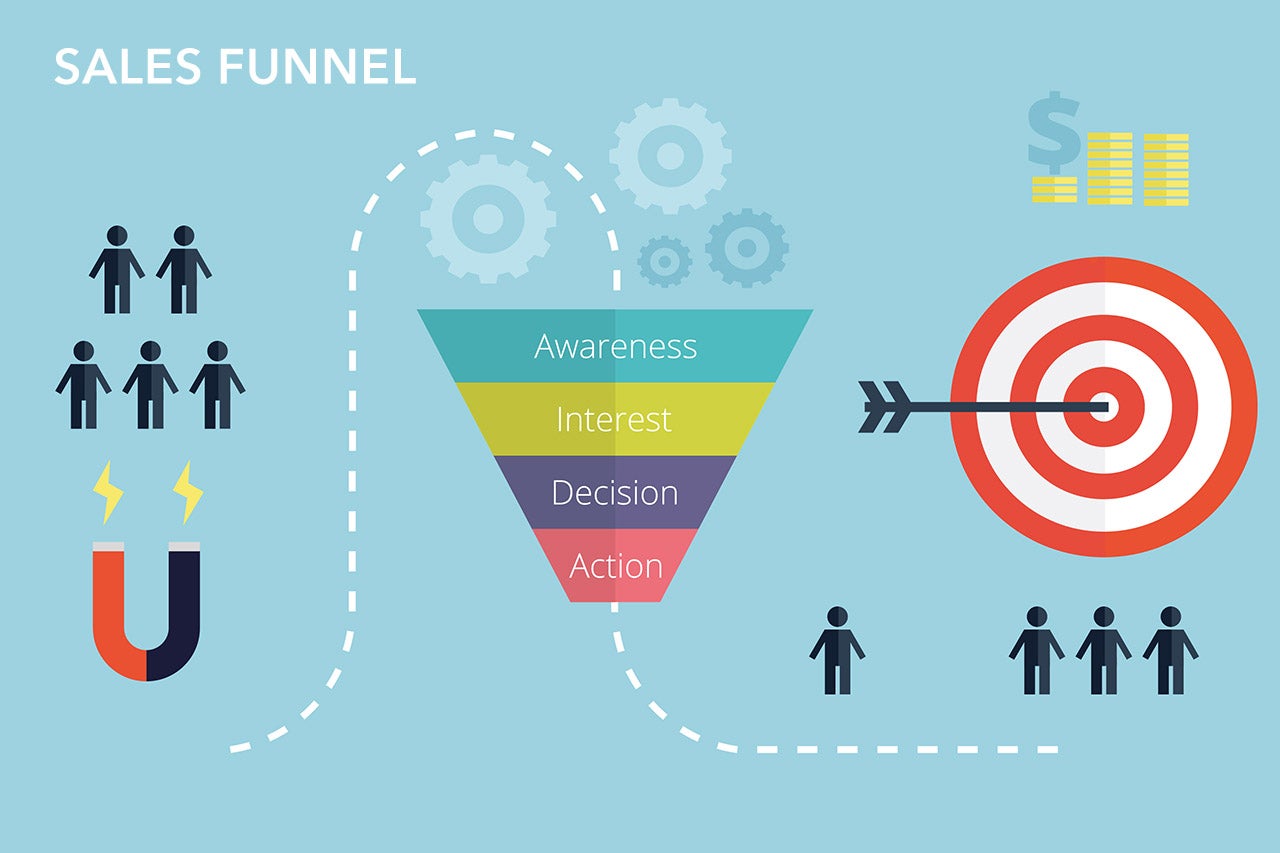
Stage 1: Awareness
What's more important about the sales funnel is what happens when those visitors (we can call them prospects) actually do arrive. Through a variety of means, many of which you've already seen, such as email newsletter signups, ebook downloads, online quizzes and more, those prospects enter into your sales funnel through an enticing offer.
The goal of your entire sale funnel and platform is to solve your customer's problem. When you know the problem, and you build content to draw them in, then offer them a product or service to solve their problem, that's when the real magic happens. However, getting to that stage takes work and you have to garner their awareness first.
For example, when a customer finds you organically through a Google search for example, that means you have some element of authority. When you have authority, prospects are more likely to enter into your funnel because they know that if they found you relevantly, that whatever it is that you're providing must be of a great value. That's just the nature of SEO and organic search.
Of course, regardless of how they enter into your funnel, your goal as a marketer is to move them through the multiple stages that will take them from prospect to buyer. And once they're aware of you, you need to build their interest. To do this, you need to establish a relationship with the customer. You might have enticed them with a great offer (lead magnet) to grab their email address, but actually moving them through the funnel is a far greater challenge.
The truth? People are smart. They're not simply going to buy anything from anyone unless they feel there's an immense amount of value to be had there. Thus, your funnel needs to built that value and bake it in through a variety of means. But most importantly, you have to create a strong bond with your prospect, and that happens by being relatable, honest and transparent in your email warming sequence.
Stage 2: Interest
You gain the prospects interest through an email sequence. You begin to relate stories to them that tie into who you are and how you've arrived to this point in your life. Brunson, in his book, Expert Secrets, calls this the Attractive Character. Are you the reluctant hero whose journey happened almost by mistake, but you feel like you owe it to yourself and the world to convey something of great value?
Or, are you a leader, an adventurer or an evangelist? How you position yourself is entirely up to you, but your message must be consistent throughout your entire "pitch" and it needs to be steeped in the truth. Your backstory, and just how you convey that through parables, character flaws and polarity, has much to do with just how well you can "hook" in your prospects to create a mass movement.
In a recent conversation I had with Perry Belcher, co-founder of Native Commerce Media, he told me that you also need to train your prospects to click on links. For example, you could have them click on a link of what interests them or link them to a blog post or eventually to a product or service that you're selling, but you need to train them to build a habit of clicking on those links from the very beginning.
Stage 3: Decision
The next stage is the decision. Getting prospects to make a decision isn't easy. The best way to get them there? Beyond the art of story telling, copywriting and building the habit of link-clicking, you need to have lots and lots of customer reviews and testimonials. This is one of the most powerful ways that you can get people to take action.
Of course, if you're going the paid ad route, you could also use Facebook and Google re-targeting to keep that awareness and interest level high. For example, if you've ever noticed after leaving a particular website, that you begin to see their ad everywhere, there's a particular reason for that. Especially if they've already entered your sales funnel, this is a very powerful way to get them to act.
For example, you could show them re-targeting ads that have video testimonials or reviews by other customers. If you have media publications that have written about you, you could take that opportunity to highlight those. When they see this in your sales funnel and you follow them around with re-targeting, it's simply an added element of exposure.
But however you get them to decide to act, flipping that switch isn't simple. You need to present them with a great opportunity and use Robert Cialdini's 6 principles, outlined in his 1984 book, Influence, in one way or another to move them through this stage:
- Principle of reciprocity -- This is achieved by delivering lots of value, either through whatever it is that you provided them as a free offer (lead magnet) in the very beginning, or in an ongoing exchange through your emails.
- Principle of commitment & consistency -- When people commit to something, they're far more likely to purchase from you. That's why getting them to agree to something like a free + shipping offer or by agreeing with something you've said in some way. This is a powerful principle in sales and if you pay attention to some of the best marketers in the world, you'll notice that they work fervently to get your commitment to something, even if it's very small in the beginning.
- Principle of liking -- When people like you (i.e. they relate to your stories) they are more likely to purchase something from you. How well you craft your story and convey that to your prospects is going to play a big role in whether they decide to act or not.
- Principle of authority -- How much authority do your products or services have? Are their respected people in your community that have endorsed it? Scientific studies that are backing it? Are you yourself an authority? All these elements come into play in this process.
- Principle of social proof -- Do you have social proof? Are people on social media raving or talking about how great your products or services are? Do you have some other type of social proof? Best-selling books? Something else? It's important that you present this to prospects if you do have them.
- Principle of scarcity -- How much scarcity have you baked into your email sequence? Again, people are smart, but when you apply the principle of scarcity, as in there are only a limited amount of some offer or time left before a discount expires or slots available for an online class, it entices people to take action.
Stage 4: Action
The final stage of the sales funnel is the action that you're intending them to perform. In most cases this is the purchase. Again, how well you move them through the various stages is going to set you up with a specific conversion for this action. For example, if 100 people click on your offer and 10 people enter your sales funnel but only purchase people purchase, then you have a 2 percent conversion.
However, the best part about this, and the most powerful route that entrepreneurs take to scale their businesses, is that if you know that sending 100 people to your site costs you $200, for example, but you get two people to convert at $300 each, then you have a $600 return on $200 invested (300 percent). When you know that, that's when the entire game changes and you can infinitely scale your offers.
However, getting to this stage is no simple feat. It takes an enormous amount of work and effort plus tracking. By implementing sales funnel software, such as the platform built by Brunson, you can definitely cut down the headache, but there's still lots of work to be done. Copy needs to be written, tracking pixels need to be installed and email sequences need to be created. But that's what it takes to succeed.
Think about that the next time you're building out a sales funnel. This complex and intricate concept in business can literally take you from a complete unknown to a global powerhouse quickly through the art of scaling out a highly-converting offer. Don't try to take shortcuts or implement hacks, and put in the time if you're looking to eventually reap the benefits and results.
Comments
Post a Comment